Forthcoming/2025 Lecture and video installation, 20′
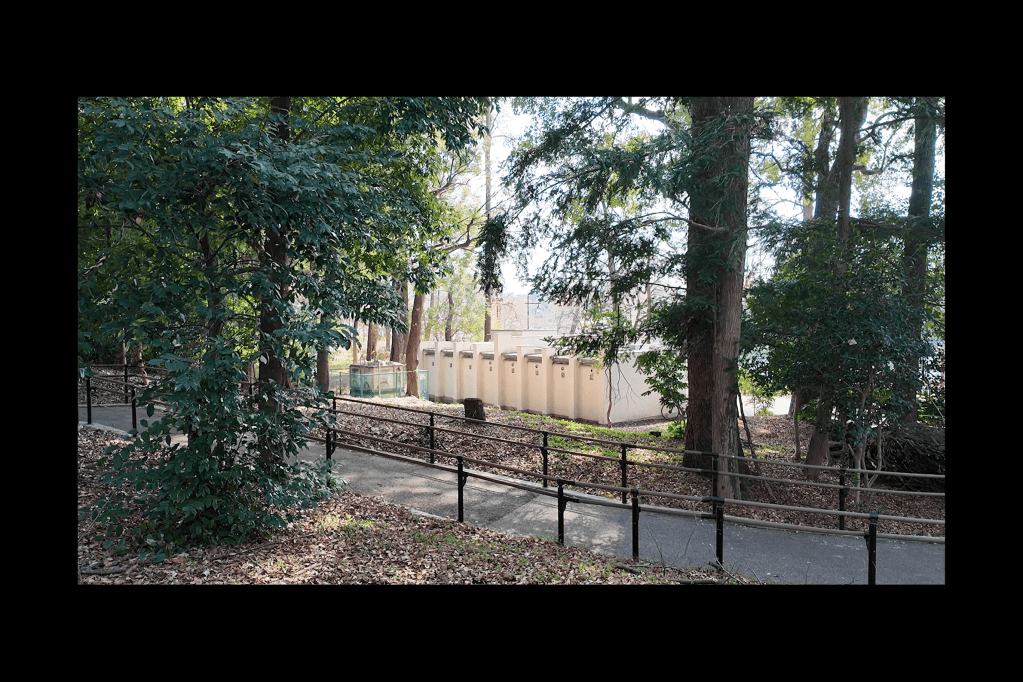
Evil’s aporic intelligence: it retreats from existence before genesis yet casts us into the horror of its absence. AKA Dr Lecter is a performance meditation on the poiesis of evil, staged at the vigilance of a public park in urban Tokyo–where an impossible act of murder took place.
Manuel Graf/ Ho Rui An/ Lin Yi-Chi/ Jongkwan PAIK/ Tzu-An Wu/ Tan Jing
The word liminal comes from Latin “limen”, meaning threshold, the state of in-between.
Liminal space is a transitional space that has been abandoned, a corridor between this reality and the next, a time between what is and what will be, a permanent present frozen in uncertainty. It is the sound of alarm we incorporate into our dreams just before waking up, a shopping mall or a museum at night, a temporary hospital built in ten days, a hotel reconstructed for quarantine purposes…
Haunted by the sick, the abnormal, ghosts, magical creatures, sacred or uncanny objects, the unknown or the non-being, liminal spaces tend to give birth to violent / subtle / poetic / eerie enunciations, manifested as forms and images of phantasm, mirages of fractured memories, urban myths, conspiracy theories, or just an accidental non-event. These expressions are the symbolic and material tether between here and beyond, between the red pill and blue pill, between the imaginary and the real. What they might produce: an indeterminate, churning intensity; an automaton capable of subverting the politics of daily life, traversing the boundary of subjective thinking, and reconfiguring our cognition of the past and future; a “pineal eye” that sees and burns its way to the Outside.
“The eye […] is not a product of the understanding, but is instead an immediate existence; it opens and blinds itself like a conflagration, or like a fever that eats the being, or more exactly, the head.” (Georges Bataille)
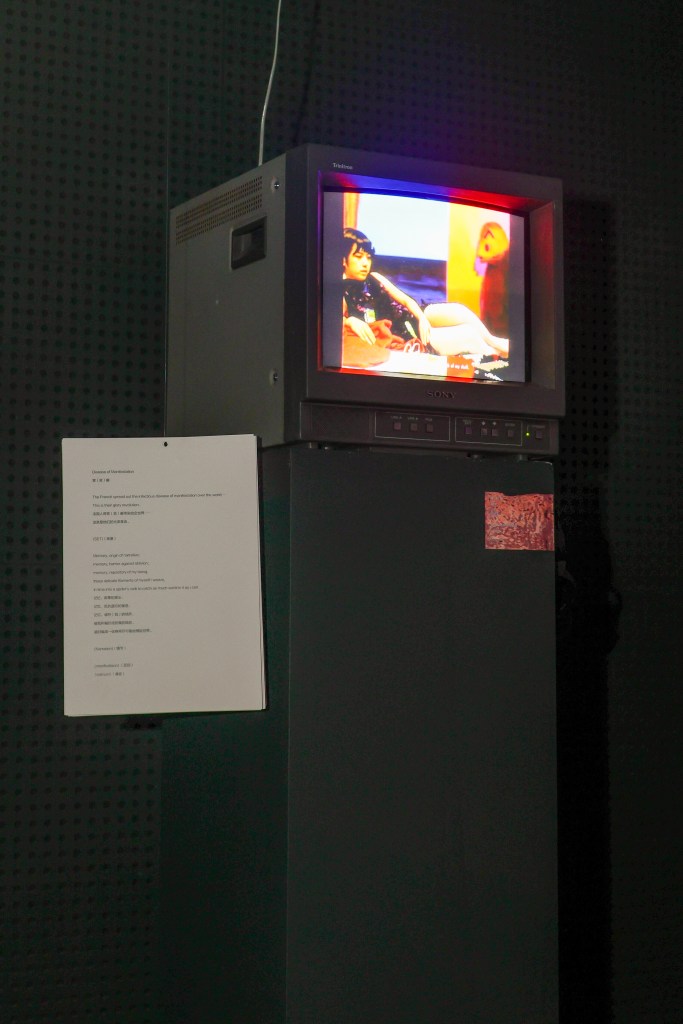
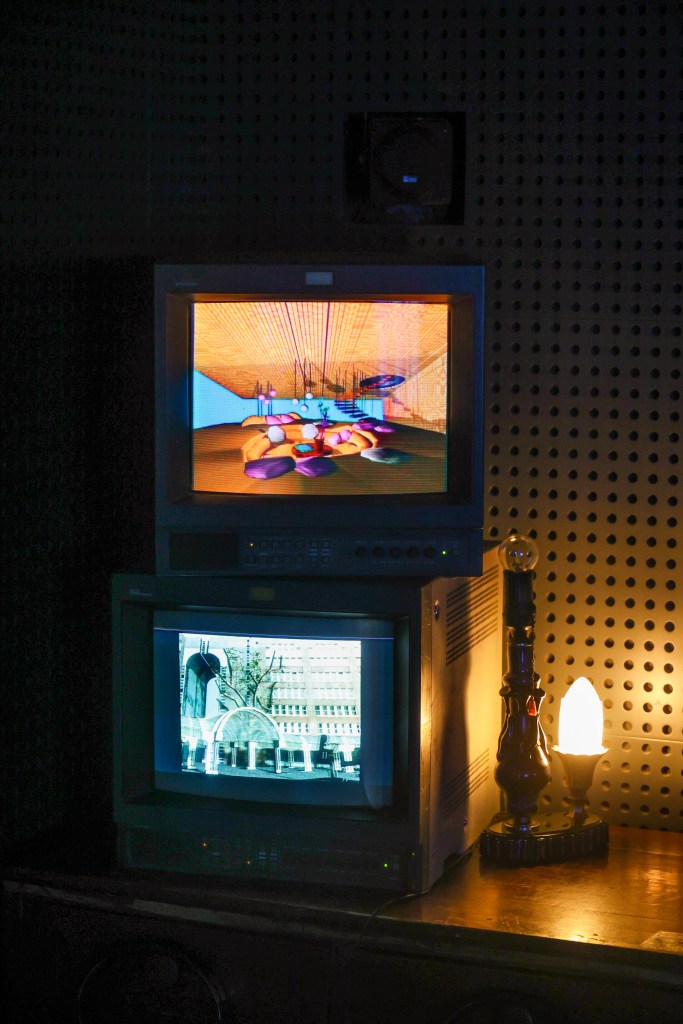
Our aim is to expose and explore the mechanisms and potentials of liminal spaces. What is shown here is neither pathological symptoms nor psychopolitical projections, but a series of liminal portrayal of contemporary spatialities, cataloging different modes of resonance and interaction with such spaces, be it in the form of a festive ritual on the ruins of a settler village, the self-corrosion of layered fragments of urban memory, a postpolitical pastiche of left melancholia, a vision of ghosts haunting the faces of nameless protestors, or be it romantic explosion of fictitious images, mythic spaces on a turntable, psychic interplays between human and things… We have one foot stuck in the quicksand, simultaneously captured and seduced by it.
What does it mean to suddenly find ourselves in an inescapable liminal space under the ongoing pandemic conditions? Why does it matter for our crisis-ridden reality, for our indeterminate past and unforeseeable future? In this instance, are we merely spectators, or have we already become ourselves a spectre in the (hi)story?
‘It is a fearful thing to fall into the hands of the Living God’
—Robert W. Chambers, ‘In the Court of the Dragon’
Nightmare Frontier[1] is the casino Over-the-Counter of the Black Market of inner night, where (dis)organizations of the lines of abject leakage, which bred the Dream, are manoeuvred. The multi-cephalised creatures in Nightmare Frontier are the abstract re-encryption of the horrorscape design that ‘craft(s) a multitude of interdependent inter-strangling[annihilative] relationships and [disturbing] (non)sequences ― [a ruinous] platform putty cave for inflecting a stream of [abjects].’[2] In this re-encryption, even reverse-leakage of abject-form could not make it through. Any ‘spawning’ or ‘hyperplasia’ would be involuted back to the pores and traps with fleshy hooks of Nightmare Frontier instead of amounting to the notoriety of production in the recursion of perturbation. The bell of The Night of the Hunt tolls for the gamble of nightmare, while the trade of abject is terminated. The saying, older than the time when humans made the first real estate trade with planetary virus and the ribbon-cutting ceremony of the trade centre (the First Dream of raping), goes, ‘what happens in Vegas, stays in Vegas.’
The failure of the School of Mensis lies exactly in that they took the gamble as a trade. They believed in the contact (contract) with Amygdala and the Brain would lead them to the Formless Oedon. The problem is not the abjectile where you convolute yourself into the fearful gain but the impossibility of any projection. Doing trade on a gamble table would only earn back your gamble money at best while you have to swallow this ‘deadpan’. This is the logic behind the Brain and the One Reborn: the chips have only exchange values to other chips.
Therefore, the School of Mensis is still the crippled ‘artists and artisans’[3] who cannot help but jabber their devotion to the abject and their concubinage to horror. Nick Land, first detecting this syndrome in Artaud, attempts to extrapolate this horror to Kant, the deep one’s transcendental a priori as the first alien invasion, the horror of anonymity before the philosopher’s time[4]. Without revoking this, one of the connotations is that the God (Kant) is crippled because he speaks, speaks into his shock attack. This is traders’ act. A deal has to be proclaimed to put in effect. Abject waits for an open orifice, a rippling cord, and a twisted complexion to accomplish the reverse leakage. The strategy of real gamblers, the hunters, however, is their silence and anonymity. Hunting must be carried out muted; gamblers never speak as they toss a dice. Their mask, not protecting them from Beast Blood whatsoever, is to grant their anonymity into the same anonymous Nightmare Frontier.
The silence and anonymity are not some sympathetic rituals in mimicry to the Nightmare, secretly desired by whom for an upcoming humiliation (Ludwig, The Holy Blade), nor a leap of faith-trade in the last instance after the humiliation (The Healing Church). The Gambler is fully aware of his entrapment in the eye pupil of the scourge of beasts. But there is no horror in the mushy eye pupil. Rather than ‘bloodborne,’ it is stunningly ‘airy,’ dematerialised to an airborne extent. As the hunting-gambling hand wielding through the air in silence and anonymity, hitting or dicing matters little compared to the demeanour of marking and tossing. The subtractive addition to the unfolding of subtraction itself.
Gambler is always the third one, the one between ones and zeros ∞[5], the third gender, or the gender+ noun at all times, between man and woman, human and demons. While zero ∞, by its skillful mimicry and clandestine treachery, are piecing the ones in its infinitesimal horroscape of decay[6], gamblers, kept opening to both ones and zero ∞ blackboxing each other, are sliding back and forth in its airborne silence without looking (distancing-entity) or touching (hapticity-weaving). Gamblers are not unseen or the impossibility of seeing as the zeros ∞ are, rectified by Oedipus-Kant or magmilised by his horror. Instead, gamblers are those who are not bothered, the silent Hermes glitchily hanging in midair. For gamblers, the most important thing is to follow a guide (manuscript) of tiresome dumbness to mask themselves as both the authority and the bait, while in their stupidity, they are ‘truly’ the authority and the bait. Being a diabolic fool, Antonio da Montolmo the Magus could sit on his chair of astrology at the University of Bologna for his entire life unbothered by the inquisition.
Magi only know two things, and two things are way more than enough. One is the knowledge of proximity rather than ontologies. It is enough to know that demons they are going to toes about live in the air below and beyond the moon. As the magus’ hand sweeps across the air, a finger snap would not make any echo. Second is the knowledge of transparency rather than mirror. A triangular crystal or a non-eventful sin is enough to make cross tangent with the indifferent astral trajectory of demons. And with these two pieces of knowledge, an empty pact shall be deemed. A pact has to be empty because in a gamble, the clauses are less important than the signatures. ‘Sign it, please,’ says both the demon and the magus, and they could go on minding their own business unhampered. The biggest mistake made by artists after Kant is that they learned to read the clauses, and by which the green lizard creeps back to their artificial arm, ending up breaking the machine of baroque. However, Urbain Grandier, aware of this secret, maintained the silent illiteracy (re)leasing the pact in the enclosed wall of the Ursuline convent.
Surely, the hunters know the Nightmare Frontier will finally swallow them. The first lesson for being a hunter is to learn about the Beast Blood and its inevitable reverse-leakage. Indeed, Faust’s responses are not out of fear, but out of his duty as a magus and his pact with Mephistopheles. Or so to speak, making a pact with a demon is the reason to be and to continue to be airborne, to be a magus. The numbers will come, but not now, not tonight. “It always comes down to the hunters,” says Gehrman, the First Hunter. “Tonight, Gehrman joins the Hunt.”
[1] See Bloodborne. FromSoftware, 2015, PlayStation 4.
[2] The text within brackets was ad-libbed from the Nightmare encryption within the skeleton of Elytron Frass’s definition of the abject-form. See Elytron Frass, ‘Alt Economy of Inner Night’, Vast Abrupt, October 21, 2019.
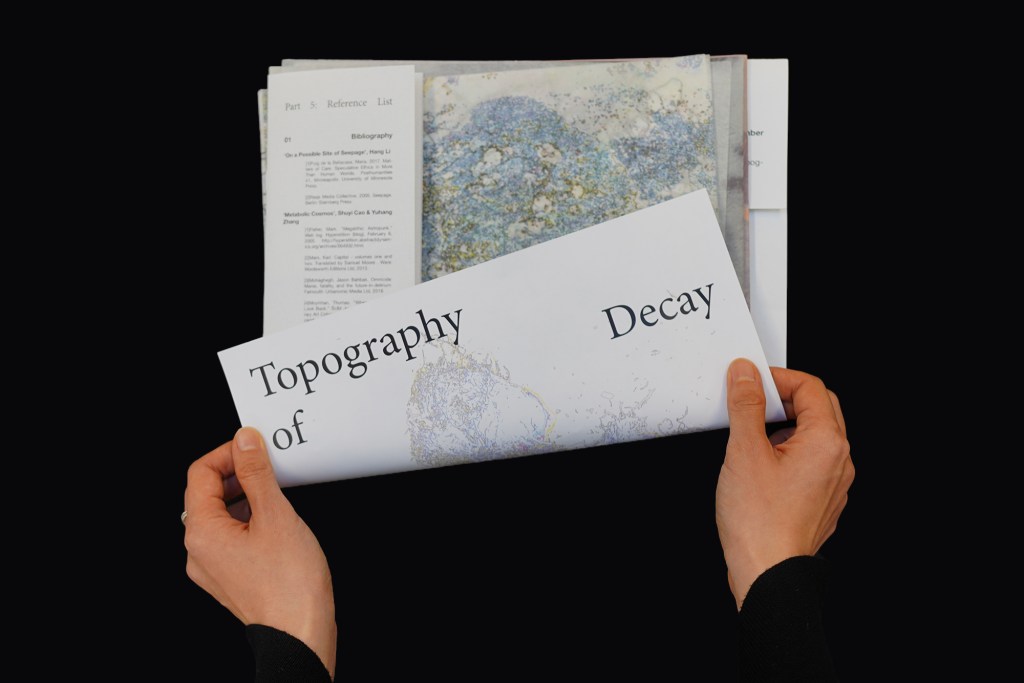
‘Topography of Decay’ is a multi-part programme series hosted by Asymmetry Art Foundation, comprising a self-published zine and artist book, a panel discussion, and open library sessions on the themes of queer ecology, geotrauma, and risk capitalism. Synthesising drawing, storytelling, and artist-book making, ‘Topography of Decay’ imagines different trajectories to understand the deadly matters that intertwine with the detritus of capitalism and dark ecology, in horror and in hope.
The artist book comprises of writings, diagrams, and research visuals made by artist and educator Shuyi Cao, writer and critic Yuhang Zhang, and researcher Hang Li as a research collective. Coming from divergent standpoints while sharing similar research subjects, they collectively generate artistic writings and imageries during their frequent feedback to each other’s research as creative exchanges.
This self-published publication consists of a correspondence between Shuyi Cao and Yuhang Zhang titled ‘Metabolic Cosmos’ and a poetic essay by Hang Li titled ‘A Possible Site of Seepage’. A series of diagrams have mapped their research ideas to guide their discussions about deadly matters, such as decomposition, microstratification, orientation, micro-intervention, and infection. Drawing upon psychogeography and different imaging of non-human beings, the diagrams seek to visualise the tensions and distance between those subjects. It also includes visuals by Shuyi Cao from her recent research and worldbuilding approaches, and a nonlinear story written by Yuhang Zhang signposts a potential reading of the pictures through mythmaking.
It was made with the design and visual co-researching by Xinyao Huang and edited by Nick Yu.





 Yuhang Zhang